Modern industries such as steel production, power generation, shipbuilding, and heavy equipment manufacturing depend heavily on double girder overhead cranes for safe and efficient material handling. As lifting capacities increase and applications become more demanding, crane manufacturers are continuously adopting advanced manufacturing technologies to improve product quality, structural strength, production efficiency, and customization capabilities.
Traditionally, crane manufacturing relied heavily on manual fabrication, including manual welding, cutting, and assembly processes. While these methods were effective in earlier industrial stages, they often resulted in inconsistent quality, longer production cycles, and higher labor costs. Today, the integration of advanced manufacturing technologies—such as robotic welding, CNC machining, digital design systems, and intelligent production lines—has transformed how double girder overhead cranes are produced.
This article explores the key advanced manufacturing technologies used by leading double girder overhead crane manufacturers and explains how these innovations improve crane performance, reliability, and production efficiency.
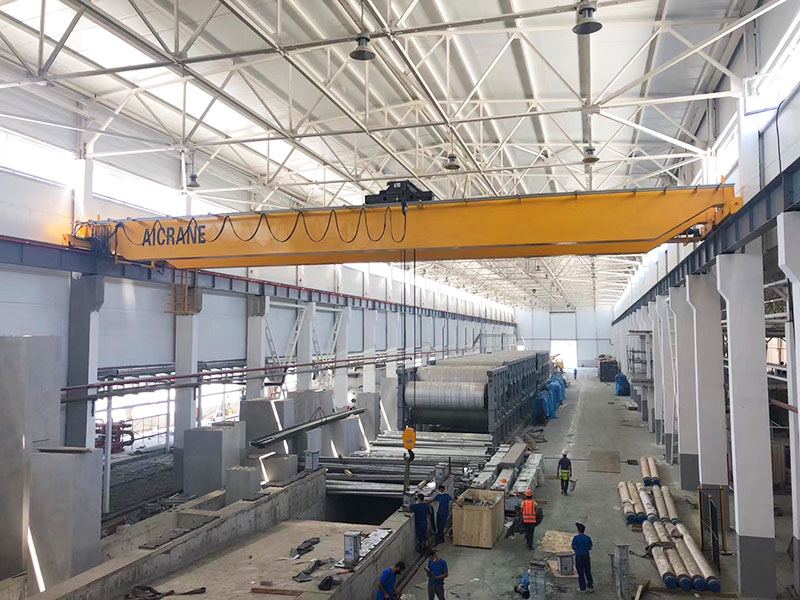
Digital Design and Engineering (CAD/CAE Technology)
One of the most fundamental technological upgrades in crane manufacturing is the adoption of advanced digital engineering platforms. Modern manufacturers use computer-aided design (CAD) and computer-aided engineering (CAE) systems to design and optimize crane structures before production begins.
Through 3D modeling software, engineers can simulate the entire crane structure, including the main girders, end carriages, hoisting mechanism, trolley system, and electrical components. This approach allows designers to evaluate structural strength, load distribution, and stress points under various operating conditions.
Finite Element Analysis (FEA) is often integrated into the design stage. This simulation technique allows engineers to analyze how the crane structure behaves under dynamic loads, ensuring that the double girder design can safely handle heavy lifting capacities such as 20 tons, 50 tons, 100 tons, or even larger industrial loads.
Digital engineering provides several advantages:
- Optimized girder structure for higher strength-to-weight ratios
- Reduced material consumption without compromising safety
- Faster design modifications for custom overhead crane solutions
- Improved compliance with international standards such as ISO, FEM, and CMAA
For crane manufacturers supplying customized solutions to industries like steel plants or precast concrete factories, digital engineering plays a critical role in delivering precise lifting equipment tailored to specific working conditions.
CNC Cutting and Precision Steel Processing
The main girder of a double girder overhead crane is typically fabricated from large steel plates and structural components. Precision cutting is therefore essential to ensure structural accuracy and alignment.
Advanced crane manufacturers rely on CNC cutting machines, including:
- CNC plasma cutting machines
- CNC flame cutting machines
- CNC laser cutting systems
These machines are controlled by digital programs that follow exact design parameters. Compared with manual cutting, CNC technology provides higher precision, smoother edges, and consistent dimensional accuracy.
Benefits of CNC steel processing include:
- Reduced dimensional errors during girder fabrication
- Faster production speeds
- Improved fit-up during assembly
- Reduced material waste
Precise cutting is especially important for heavy duty overhead cranes where large box girders must maintain strict tolerances to ensure proper load distribution and structural stability.
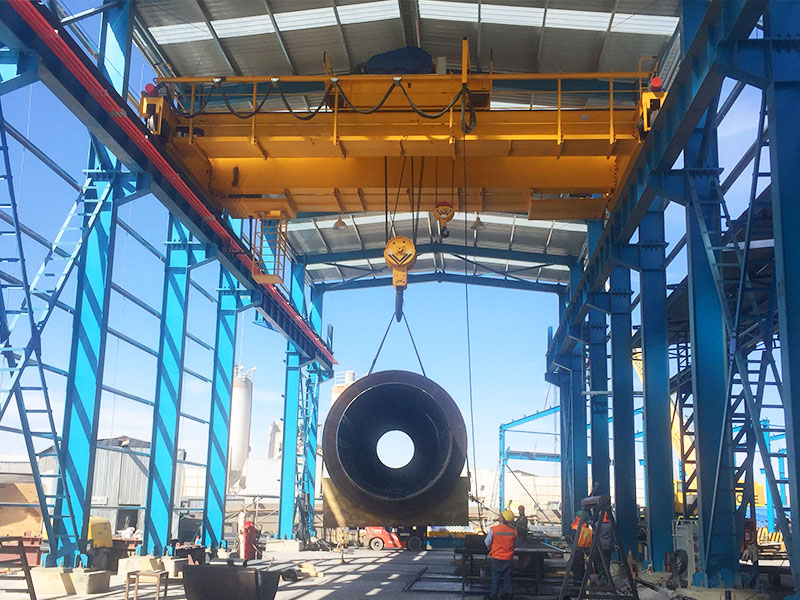
Robotic Welding Systems
Welding is one of the most critical processes in overhead crane manufacturing because the structural integrity of the crane depends largely on the quality of welded joints. Advanced manufacturers increasingly use robotic welding systems to ensure consistent and high-quality welds.
Robotic welding technology allows automated welding of large structural components such as crane girders, trolley frames, and end beams. Automated welding systems can perform multi-pass welding processes with high precision and repeatability, improving weld consistency across multiple crane units.
A commonly used process in crane manufacturing is Submerged Arc Welding (SAW). This automated welding technique is widely used for fabricating large crane girders because it produces deep penetration welds and high deposition rates.
Studies have shown that automated submerged arc welding systems can significantly improve fabrication efficiency while reducing production time for crane structures.
Key advantages of robotic welding include:
- Higher welding quality and consistency
- Reduced human error
- Faster welding speeds
- Improved structural strength and reliability
For heavy-duty double girder cranes used in steel mills or power plants, these improvements are essential to ensure long-term safety and durability.
Automated Girder Production Lines
Leading crane manufacturers have begun implementing automated girder production lines to streamline the fabrication of crane beams.
These intelligent production lines integrate several automated processes, including:
- Plate positioning and clamping
- Automatic girder assembly
- Robotic welding
- Automated straightening and inspection
Traditionally, crane girder manufacturing required extensive manual labor. However, intelligent manufacturing technologies are now transforming this process by improving productivity and consistency.
Automated production lines help crane manufacturers achieve:
- Higher production capacity
- More stable product quality
- Reduced labor intensity
- Faster project delivery times
For large-scale crane factories producing dozens or hundreds of cranes annually, these automated systems significantly improve operational efficiency.
Precision Machining with CNC Equipment
Besides structural fabrication, overhead travelling crane components require precise machining to ensure proper mechanical performance.
Key crane components that require precision machining include:
- Wheel sets
- Gearboxes
- Drum shafts
- Trolley frames
- Couplings and drive components
Modern manufacturers use CNC machining centers, CNC lathes, and milling machines to process these components with high accuracy.
Precision machining ensures:
- Smooth crane travel along runway beams
- Accurate alignment of drive mechanisms
- Reduced mechanical wear
- Longer service life of moving components
For double girder cranes operating in high-duty environments such as steel plants or automated warehouses, machining accuracy directly affects operational reliability.
Intelligent Manufacturing and Smart Factory Integration
Industry 4.0 technologies are also influencing crane manufacturing. Smart factories integrate digital management systems, automation equipment, and real-time monitoring tools to create highly efficient production environments.
In advanced crane factories, digital manufacturing systems may include:
- Manufacturing Execution Systems (MES)
- Real-time production monitoring
- Digital inventory management
- Quality traceability systems
These technologies allow manufacturers to track each crane component from raw material processing to final assembly. The result is improved quality control and better project management.
Advanced Surface Treatment and Coating Technology
Double girder overhead cranes often operate in harsh industrial environments such as shipyards, steel plants, mining facilities, and outdoor logistics yards. Therefore, surface treatment technologies are critical to ensure corrosion resistance and long-term durability.
Modern crane manufacturers use advanced coating processes such as:
- Sandblasting or shot blasting for surface preparation
- Automated spray painting systems
- Powder coating technology
- Anti-corrosion industrial coatings
Shot blasting removes rust and impurities from steel surfaces before painting, creating better adhesion for protective coatings. Automated painting systems ensure uniform coating thickness and consistent finish quality.
These processes significantly improve the crane’s resistance to corrosion, moisture, and chemical exposure.
Automation and Smart Control System Integration
Although primarily associated with crane operation rather than manufacturing, advanced control technologies are often integrated during the production stage.
Modern double girder overhead cranes may include intelligent control features such as:
- PLC-based automation systems
- Laser positioning systems
- Anti-sway control technology
- Load monitoring and overload protection
Automated cranes can achieve extremely precise positioning using sensors, encoders, and intelligent control algorithms, allowing accurate load placement in automated production environments.
These technologies are particularly valuable in industries requiring high precision, such as automated warehouses, steel production lines, and manufacturing plants.
Digital Quality Inspection and Testing
Before leaving the factory, double girder overhead cranes undergo rigorous testing and inspection processes. Advanced manufacturers use digital inspection tools to ensure every crane meets safety and performance requirements.
Typical testing methods include:
- Laser measurement systems for structural alignment
- Ultrasonic testing (UT) for weld inspection
- Magnetic particle testing (MT) for crack detection
- Load testing systems for performance verification
Digital inspection equipment provides highly accurate measurements and detailed quality records, ensuring compliance with international standards.
Conclusion
The manufacturing of double girder overhead cranes has evolved significantly with the adoption of advanced industrial technologies. From digital engineering and CNC cutting to robotic welding, automated production lines, and smart factory systems, modern crane manufacturers are leveraging innovative technologies to improve both production efficiency and product quality.
These advanced manufacturing technologies enable crane manufacturers to deliver stronger, safer, and more reliable lifting equipment while meeting the growing demand for customized crane solutions across industries such as steel production, energy, logistics, and heavy machinery manufacturing.
As Industry 4.0 continues to reshape industrial production, the integration of intelligent manufacturing systems, robotics, and digital engineering tools will play an increasingly important role in the future of overhead crane manufacturing. Companies that invest in these advanced technologies will be better positioned to produce high-performance double girder overhead cranes that meet the evolving demands of modern industrial operations.